
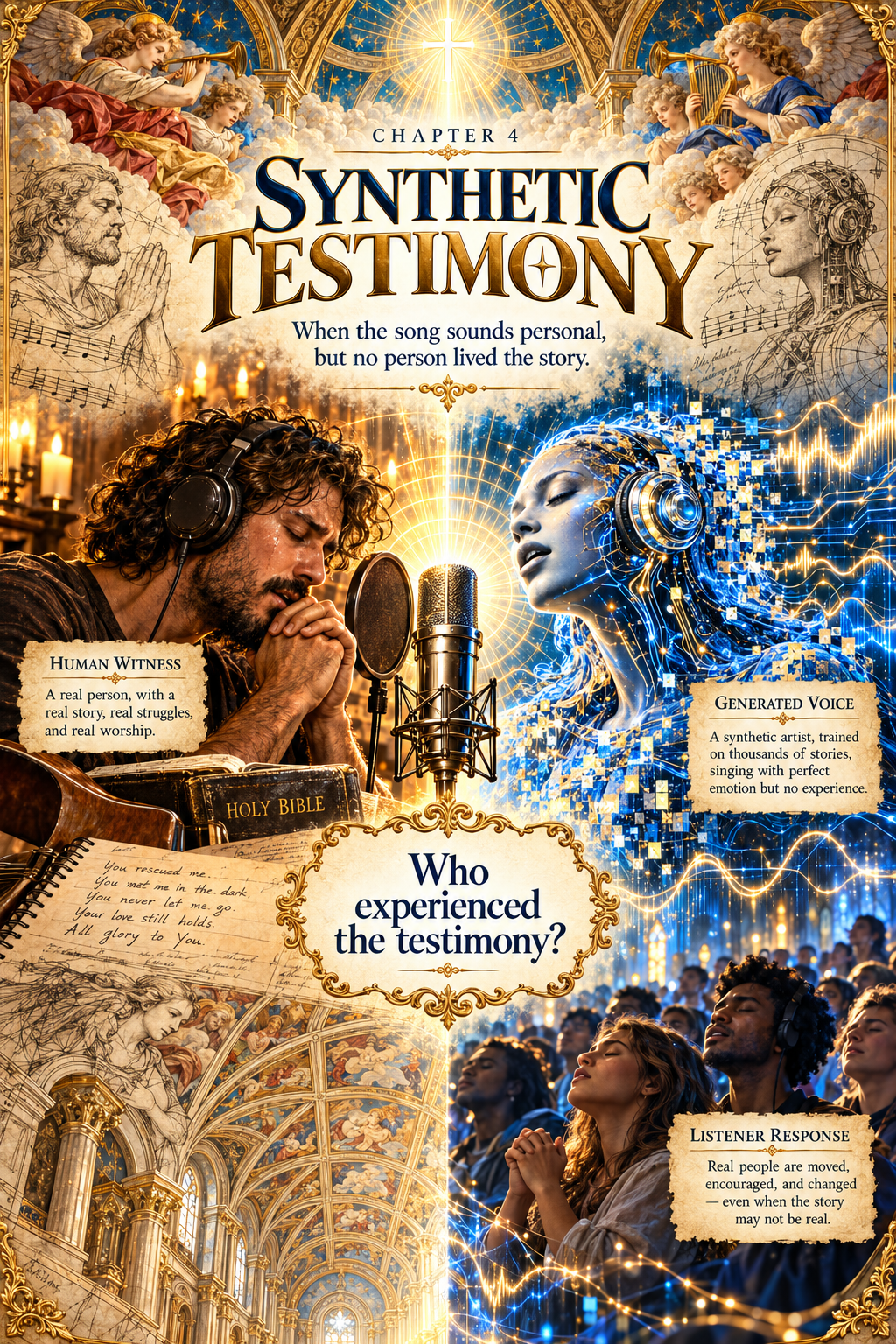
Chapter 4 — Synthetic Testimony
When a song sounds personal, but no person lived the story
Testimony carries a special weight in Christian life because it presents more than an idea. It presents a witness.
When someone says, “God met me in my grief,” the statement is not merely theological. It is personal. The speaker is claiming that something happened to them.
This is why first-person spiritual language can be powerful in Christian music.
A singer may describe rescue, repentance, forgiveness, fear, healing, doubt, or gratitude in a way that invites the listener into a human story.
Artificial intelligence introduces a new possibility: the appearance of that story without anyone who actually lived it.
Imagine a generated song that says: “I was lost in addiction, but Jesus rescued me.”
The words may be theologically sound. The melody may be moving. The synthetic singer may sound vulnerable and convincing.
But if no human being behind the song experienced addiction or rescue, then the apparent testimony is not reporting an actual event.
The same concern appears when generated lyrics say things such as: “I remember the night I gave my life to Christ,” “I buried my child and God carried me,” or “I walked away from God and He brought me home.”
These sentences are different from abstract statements of doctrine. They sound like autobiographical claims.
That does not mean every Christian song must be literally autobiographical.
Songwriters regularly write from perspectives other than their own. They may retell a biblical event, write from the perspective of a biblical character, use a fictional narrative, speak corporately as “we,” or create poetic language that represents a shared Christian experience.
There is nothing inherently deceptive about artistic perspective.
The issue is whether the listener is being encouraged to believe that a real personal witness exists when none does.
This is partly an ethical question and partly a theological one.
Christians place value on truthfulness.
If an AI-generated singer is marketed as a real convert with a fabricated biography, fabricated trauma, fabricated redemption story, and fabricated ministry identity, the problem goes well beyond the use of technology.
The issue becomes deception.
On the other hand, if a songwriter openly uses AI to dramatize a biblical story, illustrate a fictional scenario, or create a clearly disclosed artistic voice, the ethical situation may be very different.
Transparency changes the context.
This distinction also applies to human-made Christian music.
Human performers can exaggerate, fabricate, imitate sincerity, or market an image that is not true.
Being human does not automatically make testimony authentic.
Likewise, the use of AI does not automatically make a song dishonest.
What matters is what is being represented and whether that representation is truthful.
This leads to an important principle for AI and Christian music:
A generated choir singing a Psalm may raise relatively little concern.
A fictional character in a clearly identified Christian musical may also raise little concern.
A synthetic singer marketed as a real person who supposedly survived tragedy, found Christ, and wrote the song from personal experience raises much more serious questions.
The technology may be the same.
The representation is not.
Synthetic testimony therefore gives us one of the clearest examples of why the AI music debate cannot be reduced to whether the finished song sounds beautiful or contains correct theology.
We must also ask what the song is claiming about its source.