
What Kind of Music Do We Want?
Technology may change the tools, but it does not remove the need for discernment
The question “Can a machine worship?” sounds at first like a question about artificial intelligence.
In the end, it may reveal just as much about us.
What do we believe worship is?
What do we expect from Christian music?
Do we value only the finished sound, or do authorship, testimony, integrity, relationship, and human participation also matter?
Artificial intelligence has already demonstrated that many things once associated exclusively with human creativity can now be reproduced, simulated, or generated.
A system can write lyrics.
It can compose music.
It can generate a convincing singing voice.
It can imitate emotion.
It can create a face, a biography, an artist identity, and a story.
What it cannot currently establish merely by producing those forms is that a person stands behind them who believed, remembered, suffered, repented, rejoiced, gave thanks, or worshiped.
That difference matters.
But it does not require Christians to fear every use of the technology.
AI can also serve human creativity in ways that are helpful, accessible, efficient, and even compassionate.
It can restore damaged recordings.
It can assist people with disabilities.
It can help small ministries create resources they otherwise could not afford.
It can assist with arrangement, translation, production, and experimentation.
It can even generate material that a real human being later adopts in sincere worship.
That is why this book has resisted two simple answers.
“AI is evil” is too simple.
“AI is just another tool” can also be too simple.
The technology is capable of functioning in very different ways.
Context matters.
Human contribution matters.
Consent matters.
Truthfulness matters.
Representation matters.
Biblical faithfulness matters.
And trust matters.
Christians have adapted to new technologies before.
The printing press changed access to Scripture.
Radio changed preaching and music.
Recording changed the relationship between performer and listener.
Digital production changed how music is created.
Streaming changed how it is distributed.
Artificial intelligence will likely change Christian creative culture again.
The question is not whether change will happen.
The question is what Christians will choose to preserve while it does.
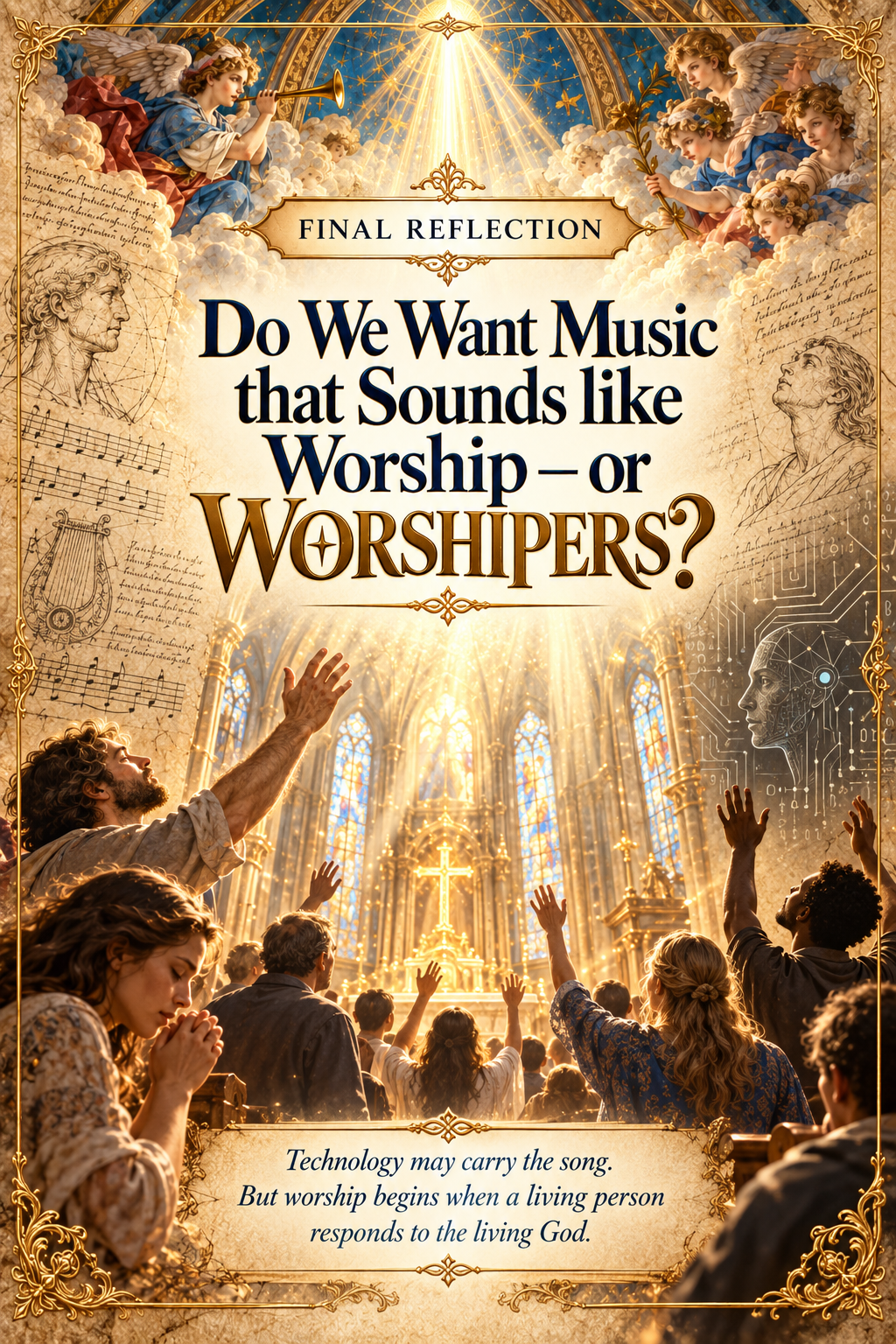
A machine may generate the song.
A machine may carry the song.
A machine may even help someone discover the song.
But worship begins when a living person responds to the living God.