
Chapter 7 — The AI Christian Music Spectrum
Not all uses of artificial intelligence are the same
One of the biggest mistakes in conversations about artificial intelligence and Christian music is treating every use of AI as though it belongs in the same category.
It does not.
There is a meaningful difference between using AI to remove background noise from a recording and using AI to invent a fictional Christian artist, write the lyrics, compose the music, sing the song, create the biography, and present the result as though a real human ministry existed behind it.
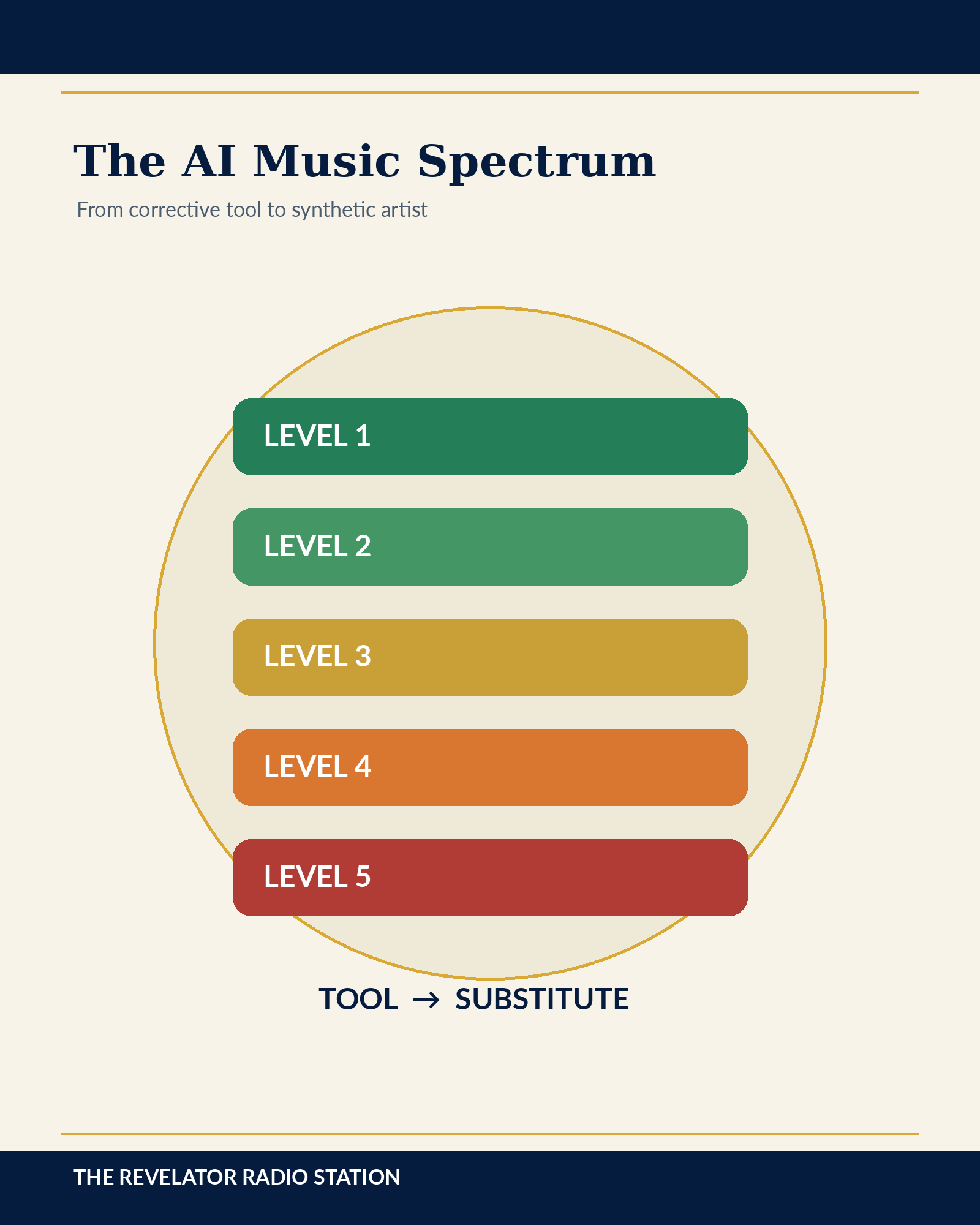
A useful way to think about this is as a five-level spectrum.
Corrective AI
AI is used primarily to repair, clean, or improve material that already exists.
Examples: noise removal, de-clicking, restoration, pitch cleanup, mastering assistance, stem cleanup, transcription, or removing unwanted technical defects.Assistive AI
AI helps a human creator make decisions or complete specific supporting tasks.
Examples: chord suggestions, lyric brainstorming, translation, arrangement ideas, mix suggestions, metadata assistance, or alternate production options.Collaborative AI
AI contributes substantial creative material, but a human remains meaningfully involved in authorship, direction, selection, revision, and final responsibility.
Examples: a songwriter provides the message and core lyrics while AI generates arrangement ideas, harmony, instrumental parts, or alternate sections that the human actively shapes and approves.Generative AI
AI generates substantial portions of the lyrics, melody, instrumentation, arrangement, production, or vocals.
A human may still prompt, edit, select, and publish the final work, but much of what the listener hears originates from the generative system.Synthetic Artist
Most or all of the artist identity, songwriting, composition, voice, performance, visual image, and public persona are generated.
This level raises the greatest questions about authorship, testimony, disclosure, identity, consent, and what listeners believe they are encountering.The purpose of this spectrum is not to automatically declare one level righteous and another sinful.
It is to make the differences visible.
For example, few Christians would object to using software to remove a loud air conditioner from a worship recording.
That is very different from generating a fictional testimony singer and telling listeners that the singer personally survived the tragedy described in the song.
Yet both situations might casually be described as “AI music.”
This distinction is especially useful for churches, radio stations, labels, worship leaders, artists, and listeners because it avoids two extremes.
One extreme says: “AI touched it, therefore it is unacceptable.”
The other says: “It sounds good, therefore nothing else matters.”
Neither position gives us enough information.
Christian discernment requires more than identifying the tool.
It asks how the tool was used, what role the human being retained, what is being represented to the listener, and whether anyone is being deceived, exploited, or replaced in a way that matters morally.
Consider a disabled songwriter who cannot physically perform an instrument anymore but uses generative technology to hear an arrangement of a song he personally wrote from his own faith and experience.
Compare that with a publisher typing: “Create a Christian singer, write a testimony song, generate the voice, invent the biography, and make it sound authentic.”
Both involve AI.
But it would be difficult to argue that the human contribution and the representation to the listener are identical.
The spectrum also reminds us that there may not be one universal line for every Christian context.
A private songwriting experiment may raise different concerns from a congregational worship service.
A clearly fictional Christian musical may differ from a song marketed as personal testimony.
A radio station may need disclosure standards that an individual listener does not.
A church may choose stricter boundaries for worship leadership than for background production tools.
Those principles matter more than the labels themselves.
The next chapter will examine one of the strongest arguments Christians can make in favor of using artificial intelligence in music.