
The Strongest Christian Argument for AI
If artificial intelligence is going to be evaluated fairly, Christians should resist the temptation to argue only against its most troubling uses.
Fully synthetic artists, fabricated testimony, deceptive voice cloning, and false biographies raise serious concerns.
But those examples do not represent every possible use of AI.
There is also a strong Christian argument that technology can serve human creativity, increase accessibility, reduce unnecessary barriers, and help people communicate things they genuinely believe.
1. Tools Do Not Have to Be Worshipers
A guitar does not worship.
A microphone does not worship.
A mixing console does not worship.
A radio transmitter does not understand the Gospel it carries.
A printed hymnal does not believe the words on its pages.
Yet Christians have long used nonhuman tools to assist human worship.
This is a major argument against simplistic claims that AI must be rejected merely because the technology itself cannot be shown to worship.
That argument proves too much.
Most instruments and technologies used in Christian music are not themselves worshipers.
The more important question is what role the technology is playing.
2. Scripture Includes Skill, Instruments, Organization, and Training
1 Moreover David and the captains of the host separated to the service of the sons of Asaph, and of Heman, and of Jeduthun, who should prophesy with harps, with psalteries, and with cymbals: and the number of the workmen according to their service was:
6 All these were under the hands of their father for song in the house of the Lord, with cymbals, psalteries, and harps, for the service of the house of God, according to the king's order to Asaph, Jeduthun, and Heman.
7 So the number of them, with their brethren that were instructed in the songs of the Lord, even all that were cunning, was two hundred fourscore and eight.
What the Passage Shows
This passage does not speak about artificial intelligence.
It should not be forced into a modern technology debate.
But it does show that biblical worship could involve instruments, organization, instruction, skill, leadership, and technical preparation.
Scripture does not establish a principle that spiritual authenticity rises as technical sophistication falls.
That does not automatically justify every new technology.
It does mean that Christians need a better argument than “technology was involved.”
3. AI Can Increase Accessibility
One of the strongest positive uses of AI involves people who have something meaningful to communicate but lack a conventional way to realize it.
A songwriter may have strong lyrics but limited instrumental ability.
A person with a physical disability may be unable to perform every part of a song.
An older musician may have lost some vocal or instrumental ability.
A small church may lack musicians.
A missionary may need translation or restoration assistance.
A low-income creator may be unable to hire an arranger, session band, engineer, producer, and mastering specialist.
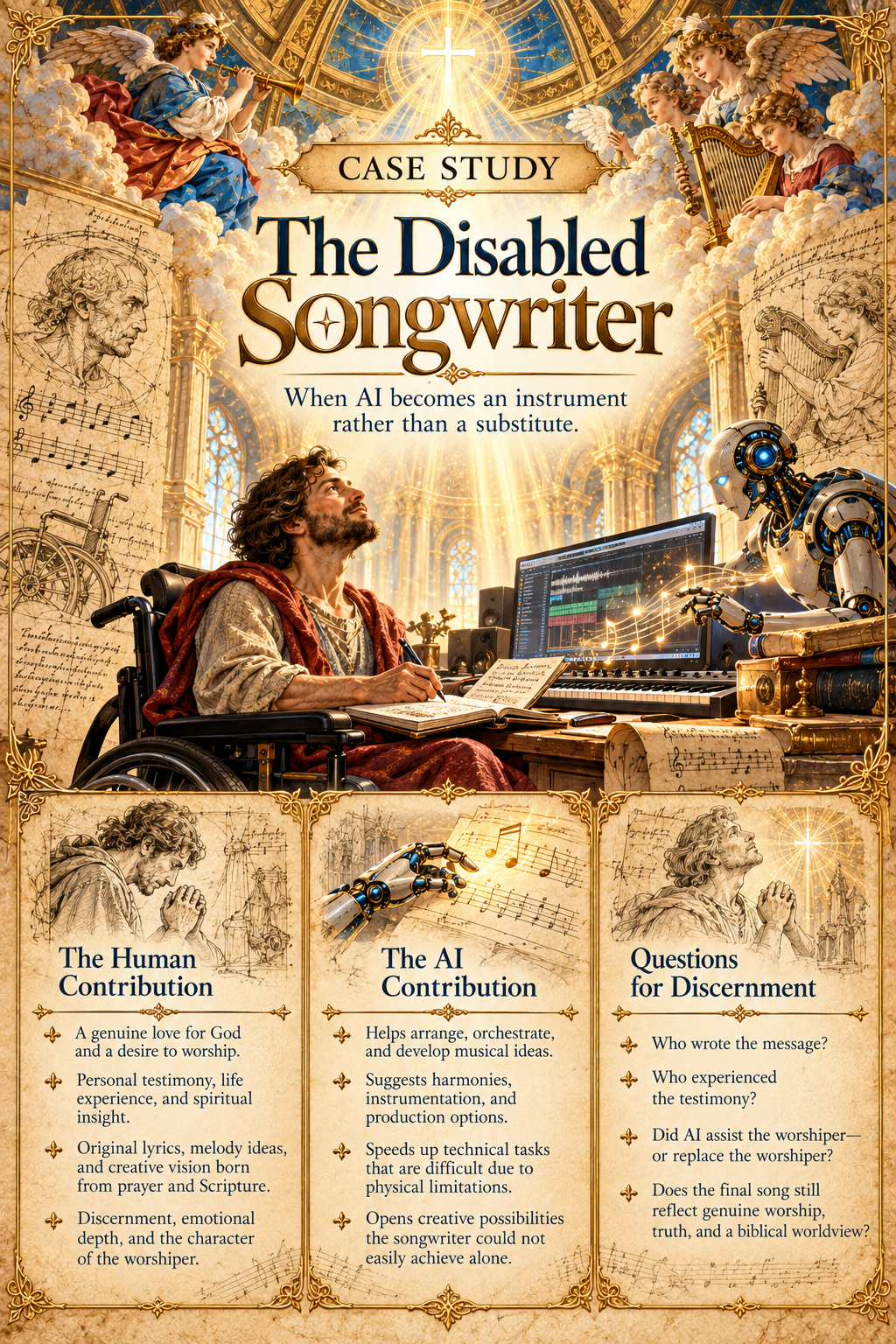
In situations like these, AI may function as an accessibility tool.
That distinction deserves serious consideration.
4. Small Ministries Can Gain Capabilities They Could Never Afford
Many churches, ministries, missionaries, and independent Christian artists operate with very limited budgets.
AI tools can assist with:
Removing noise, clicks, hum, and damage from recordings.
Turning spoken material into text for accessibility or publication.
Helping ministries prepare material for people who speak other languages.
Allowing musicians to develop songs before paying for full production.
Helping a songwriter hear possibilities for instrumentation and structure.
Offering suggestions for balance, levels, cleanup, and technical improvement.
Used in these ways, AI can lower barriers without necessarily removing the human message.
5. Truth Does Not Become False Because a Machine Carries It
Consider a simple Christian statement:
If those words appear on a computer screen, they do not become false because the screen has no faith.
If a radio transmitter carries a sermon, the truth of the sermon does not depend upon the transmitter understanding it.
If software displays a verse of Scripture, the proposition is not invalidated because the software does not believe the verse.
This is a strong argument against saying that all AI-generated Christian language must be spiritually useless merely because the system itself does not possess Christian faith.
A machine may carry a true statement.
The separate questions concern authorship, meaning, representation, and use.
6. Humans Can Sincerely Use Words They Did Not Write
Christians routinely worship with words written by other people.
Congregations sing hymns written centuries ago.
Believers pray words from Scripture.
Worship leaders sing songs written by other songwriters.
A person does not have to originate every sentence in order to sincerely adopt it.
This becomes important in the AI discussion.
Suppose an AI system suggests:
A Christian reads those words.
He considers them.
He believes them.
He adopts them as his own prayer.
He sings them sincerely to God.
The fact that AI first suggested the wording does not automatically make the human worship insincere.
7. AI Can Be a Servant Rather Than a Substitute
The strongest positive case for AI depends heavily upon this distinction.
In this model, the human meaning remains visible.
The human intention remains visible.
The testimony belongs to someone.
The songwriter's convictions remain central.
Technology helps that person accomplish something.
Compare that with:
In this model, AI begins replacing the writer, composer, musician, singer, testimony, personality, and perhaps even the apparent worshiper.
These are not the same use of technology.
8. Technology Can Preserve Human Creativity
AI does not have to lead toward a future in which human artists disappear.
Another possibility is that technology allows more people to participate in creativity.
A songwriter can hear an arrangement that was previously impossible to afford.
A disabled musician can realize a composition.
A damaged recording can be restored.
A small congregation can create accompaniment.
A missionary can prepare translated material.
A young artist can create a demo before raising money for a full recording.
In these situations, AI does not necessarily erase human creativity.
It may extend its reach.
9. Christians Should Not Confuse Difficulty With Holiness
There is another danger in rejecting technology too quickly.
We can begin to assume that the more difficult a process is, the more spiritually valuable it must be.
But difficulty itself is not holiness.
A musician does not become more spiritual because editing takes longer.
Removing noise from a testimony does not make the testimony false.
Using a digital tool does not automatically weaken faith.
Efficiency can sometimes free people to spend more time on relationships, ministry, Scripture, prayer, songwriting, or serving others.
The question remains whether efficiency is helping meaningful human work or removing the meaningful human work altogether.
10. A Listener's Worship Can Still Be Real
Suppose a Christian hears a piece of AI-generated instrumental music.
While listening, she begins praying.
She remembers God's faithfulness.
She gives thanks.
Her response can be genuine.
The synthetic origin of the sound does not automatically make her prayer synthetic.
This point will become especially important later when we ask whether an AI-generated song can become the occasion for genuine human worship.
The Strongest Positive Case
Taken together, the strongest Christian case for AI sounds something like this:
This argument deserves to be taken seriously.
It prevents the discussion from collapsing into fear of new technology.
It acknowledges that Christian music has always involved tools.
It recognizes the needs of disabled creators and small ministries.
It recognizes that people can sincerely adopt words they did not originally write.
And it recognizes that a nonhuman medium can carry truth without becoming the source of that truth.
But the Argument Has a Limit
The strongest case for AI also leads us directly to its greatest challenge.
What happens when the servant begins replacing the person?
What happens when the tool generates not only the accompaniment, but the lyrics?
Then the melody?
Then the voice?
Then the identity?
Then the biography?
Then the testimony?
That is the question Chapter 9 will examine.